Guides and free tools for aged care providers
Written for aged care CEOs, operations managers, care managers and boards who want to understand what AI can and cannot do under Australian aged care rules. Regulatory facts are checked against official sources and dated.

Free tools
Run in your browser. Nothing you enter is sent to us.
Missed Enquiry Calculator
Estimate what unanswered enquiry calls may be costing your service each year.
Admin Time Calculator
Add up the hours your team spends on phones, notes, rosters and reporting each week.
AI Readiness Scorecard
Twelve questions that show how ready your organisation is to use AI safely.
AI Vendor Checklist
The questions to ask any AI vendor before you sign a contract.
Regulation and governance
What the new aged care rules and the Privacy Act mean for AI in your service.

Aged Care Act 2024 and AI
The new Act changed who is accountable for what in aged care. It does not mention AI tools, but every duty it places on providers and workers still applies when part of the work is done with AI.

AI Governance for Aged Care Boards
Directors of aged care providers already carry legal governance duties for quality and safety. AI is now part of the operations those duties cover, and boards need a simple, regular way to oversee it.
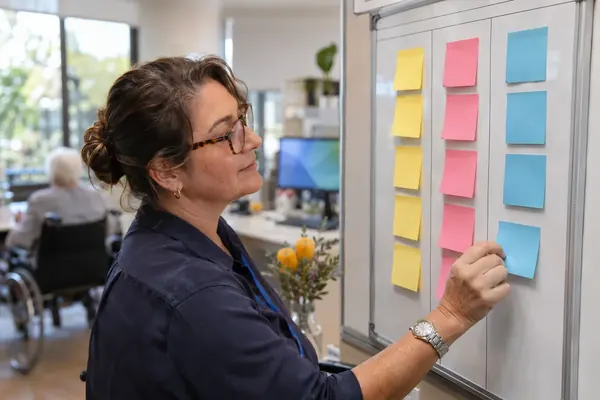
AI Implementation Roadmap
Most AI projects in aged care that stall do so for organisational reasons: no owner, no baseline, staff who were not asked, or a first project that was too large. This roadmap sets out the stages from a readiness check to use across a whole provider, with the review points in between.

AI Privacy Guide for Aged Care
Aged care records hold some of the most sensitive information a person has. Before any AI tool touches it, you need to know where the information goes, who can see it and what the law expects.

AI Risks and Limits in Aged Care
We build AI tools for aged care providers, and we think the risks deserve as much attention as the benefits. This page sets out what can go wrong, how to reduce it, and the jobs AI should not be given.

Care Minutes and AI
Care minutes measure direct care time with residents. AI cannot add a single minute to that count. What it can do is take paperwork off nurses and care workers, so more of the hours you already roster are spent with residents.

Strengthened Quality Standards and AI
The strengthened Quality Standards ask providers to show what they do, with evidence. AI can take on part of the paperwork behind that evidence. It cannot take on the clinical and care judgement the Standards are about.

Support at Home Guide for Providers
Support at Home moved in-home aged care to quarterly budgets, service-by-service claiming and monthly statements. Most of the new workload is administration, which is where automation can help.
Comparisons and buying guides
How AI compares with the alternatives, and how to choose and connect it.

AI vs Answering Service
Most aged care providers already divert some calls somewhere after 5pm. This page compares a human answering service, an AI phone agent and a mix of the two, so you can pick the one that fits your call pattern and your on-call arrangements.

AI vs Hiring Admin Staff
When the front office falls behind, the usual answer is another admin role. Sometimes that is right. This page sets out what a good admin officer does that AI cannot, which tasks AI can take off the team, and how to estimate the hours for your own service.

Aged Care Software Integrations
An AI tool is only useful if its work ends up in the systems your staff already use. This page explains the four usual ways of connecting AI to aged care software, which method suits each type of system, and what to check before anyone promises an integration.

Choosing an AI Vendor
Aged care providers are being offered AI tools by care software companies, start-ups, consultants and large technology firms. These are the questions to put to every one of them, ourselves included, and a simple way to score the answers.
What we set up
Each service, how it works day to day and what to measure.

AI Phone Answering for Aged Care
Families, prospective residents, hospitals and agencies all ring the same number, often at handover or after the office closes. An AI phone agent answers the calls your staff cannot get to, deals with the routine ones and puts the urgent ones through to a person.

Enquiry to Admission
A family looking for a place usually calls several homes in the same week, often while a parent is in hospital. The home that answers, follows up and keeps the paperwork moving is the one most likely to admit them. AI handles the follow-up so your admissions staff can concentrate on the family.

Family Communication
Families want to hear how their mother or father is going without having to chase. Care staff want to give them that, but a phone call to every family every week is not possible on a busy floor. AI drafts the updates and handles the routine questions, and staff approve every word that goes out.

Feedback and Complaints Management
Complaints and feedback arrive by phone, email, website form, a note at reception or a word to a care worker in the corridor. AI tools can make sure each one is recorded, acknowledged and sent to the right person, then tracked until it is closed, while your staff do the listening, the apologising and the fixing.

Incident Management and SIRS
When an incident happens, the details are freshest in the first hour and the reporting clock may already be running. AI tools can help staff capture what happened straight away, keep the paperwork moving and remind the right people before a deadline, while your managers make every reporting decision.

Multilingual Communication
Many residents, clients and families speak a language other than English at home, and some older people return to their first language as dementia progresses. AI translation and a multilingual phone agent can handle routine messages in their language, while qualified interpreters stay in place for the conversations that matter most.

Policy Knowledge Assistant
Your policies and procedures run to hundreds of pages across shared drives, intranets and binders. A private AI assistant lets a care worker on night shift ask a plain question and get an answer drawn from your documents, with a link to the exact policy it came from.

AI Progress Notes for Aged Care
Progress notes are often written at the end of a long shift, from memory, by a tired care worker. AI drafting lets the worker speak or type what happened in their own words and get back a clear, objective draft to check, correct and approve.

Recruitment and Onboarding
Good applicants for care roles are often gone within days, and the ones you hire need a stack of checks and induction before their first shift. AI handles the scheduling, reminders and paperwork tracking so your HR staff can spend their time talking to candidates.

Reporting Automation
Quarterly financial reports, care minutes, quality indicators, board packs: much of an aged care finance and quality team's quarter goes into pulling data out of several systems, checking it and putting it into the right format. Automation can do the gathering and checking so your people spend their time on review and sign-off.

Rostering and Shift Fill
A care worker calls in sick before an early shift. Someone has to log it, find a replacement and keep the floor covered, usually the RN in charge who is also starting the medication round. AI takes the sick call, messages the eligible casuals and tells the roster coordinator who has accepted.

Staff Training with AI
Aged care staff need to know your policies, apply them on a busy shift and keep up as they change. AI can turn the policies you already have into short refreshers, quizzes and practice scenarios, so your educator spends less time writing material and more time with staff.

Support at Home Claims and Invoicing
Support at Home turned claiming into a monthly and sometimes weekly routine: service records checked against care plans, claims prepared for Services Australia, participant contributions invoiced and a plain-language statement sent to every participant. Automation can do the checking and preparation, so your finance team handles exceptions instead of every line.
By provider type
Residential, home care, community care and retirement living.

CHSP Providers
CHSP services see a lot of clients for small amounts of support each, on block grant funding that leaves little room for administration. AI can take on the high-volume, low-complexity admin so a small office keeps up.

Home Care Providers
Home care coordination is a moving target: workers call in sick, clients cancel, families ring with questions, and every service delivered has to line up with a participant's budget before it can be claimed. AI handles the repeated parts so coordinators can deal with the exceptions.

Multi-Site Aged Care Groups
A group with five homes usually has five slightly different ways of answering the phone, logging an enquiry and chasing a family. AI tools set up once at group level give every site the same process, while each home keeps its own staff, contacts and local detail.

Not-for-Profit Aged Care
Community, church and charitable providers run aged care on tight margins with boards that ask hard questions about every new system. AI can save staff time, but only if it is adopted carefully, fits your values and can be explained to your board and your community.

Residential Aged Care
A residential aged care home runs around the clock, but its office runs business hours and its nurses are busy with residents. AI can take the repeated admin around handover, family contact, admissions, rosters and reporting, so staff time goes back to the floor.

Retirement Villages
A retirement village manager is often a sales team, a maintenance coordinator, a community organiser and a complaints officer in one role. AI can take the repeated enquiries, requests and notices so the manager has time for residents and prospective residents.

Rural and Remote Aged Care
In a country town the facility manager may also be the admissions officer, the roster coordinator and the person who answers the phone at 6pm. AI tools take the routine part of that load so a small team can spend its time with residents and clients.
Not sure where to start? Talk it through with us
A free 30-minute video call about where admin time goes in your service and whether AI would help. No resident information needed.