Language and culture
Multilingual communication for aged care with AI
Many residents, clients and families speak a language other than English at home, and some older people return to their first language as dementia progresses. AI translation and a multilingual phone agent can handle routine messages in their language, while qualified interpreters stay in place for the conversations that matter most.
Reviewed 15 November 2026

In short
Multilingual communication for aged care with AI covers three things.
First, routine written messages (visit reminders, menu changes, activity notices, newsletters, appointment confirmations) translated into each family's preferred language and approved by staff before they are sent. Second, a multilingual AI phone agent that can answer routine calls from families in their language, take messages and pass a written summary to staff in English.
Third, clear rules for when AI is not enough: care planning, consent, fees, clinical updates, complaints and end-of-life conversations need a qualified interpreter. The Department of Health, Disability and Ageing funds TIS National interpreting at no cost for approved providers of eligible aged care programs, and runs a free aged care translation service for print and digital materials.
AI fills the gaps between those services for routine contact. It is set up with your staff and community advisers so messages are respectful and culturally safe.
The communication gap for CALD residents and families
Aged care homes and home care services in most Australian cities support older people from many language backgrounds: Italian, Greek, Vietnamese, Mandarin, Cantonese, Arabic and many more. Often the older person's adult children speak English well, but a spouse, sibling or the older person themselves does not. Some older people who spoke English for decades lose it as dementia progresses and return to their first language.
In practice this means routine information does not reach everyone. A newsletter in English goes unread by a resident's wife. A change to visiting arrangements is explained to one daughter and not passed on. A home care client does not understand a text saying their care worker is running late, and rings the office in distress. None of these are care decisions, but each one affects how safe and respected the person feels.
Translated routine messages, approved by staff
For routine written messages, the AI produces a translation into each family's recorded preferred language, alongside the English original. A staff member checks the content before it is sent; where a staff member reads that language, they check the translation too. Over time you build a library of approved translations for messages you send often, such as visiting hours, how to raise a concern, what to bring for respite and how to read a Support at Home monthly statement, so most messages reuse wording that has already been checked.
Machine translation is good for short factual messages and less reliable for idioms, humour, emotional content and medical terms. We set the tool to keep messages short and literal, avoid idioms, and flag any message that contains health information, fees or consent for a person to decide whether an interpreter or a professionally translated document is needed instead.
| Communication | Suitable approach | Why |
|---|---|---|
| Activity notice, menu change, visiting hours | AI translation approved by staff | Short, factual and low risk |
| Care worker running late (home care) | AI translated text from an approved template | Routine and time-sensitive |
| Newsletter or information sheet | Free aged care translation service, or AI draft checked by a fluent reader | Longer and kept for reference |
| Care plan review, consent, fees | Qualified interpreter (TIS National or your own) | Decisions and rights are involved |
| Clinical update after a fall or hospital stay | Qualified interpreter | Accuracy and questions matter |
| Complaint, open disclosure, end-of-life care | Qualified interpreter, in person if needed | Sensitive and needs trust |
A multilingual phone agent for routine calls
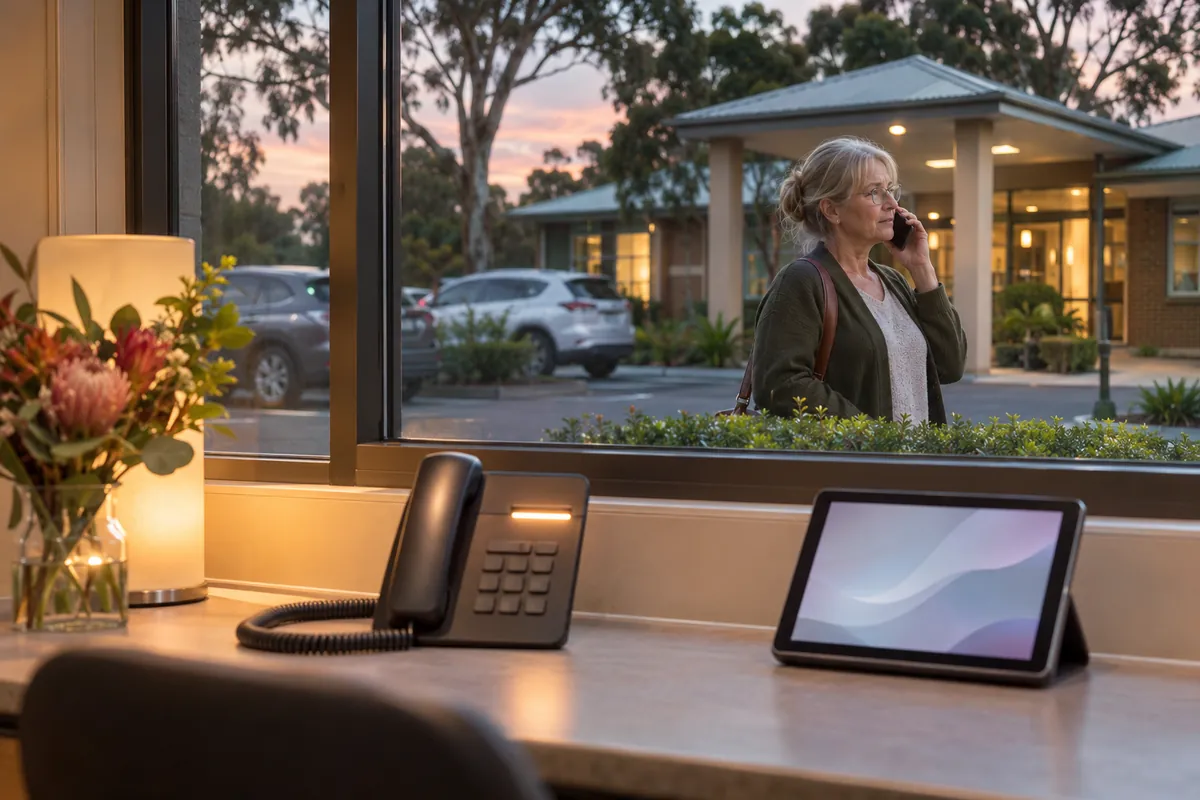
An AI phone agent can be set up to greet callers in English and offer other languages, or to detect the language the caller speaks and answer in it.
For routine calls (leaving a message for a nurse, asking about visiting, letting the home care office know a client will not be home tomorrow, booking a time to talk to the manager) it handles the call in the caller's language and sends staff a summary in English, with the caller's preferred language recorded so the call back can be arranged with an interpreter if needed.
The agent follows the same rules as an English-language agent: it does not give clinical information or discuss a resident's condition, it tells callers to ring 000 if life is at risk, and it transfers urgent calls to a person. If the call is about something that needs a proper conversation, the agent tells the caller that a staff member will call back with an interpreter.
Check whether this fits your service
A free 30-minute video call. We look at your call volumes, systems and where staff time goes, and tell you whether this is the right first step. No resident information needed.
When a qualified interpreter is required
AI translation does not replace qualified interpreters. The Department lists the purposes for which approved providers can use TIS National at no cost, including discussing care needs, services and preferences, discussing fees and charges, developing or reviewing care documents such as agreements, care plans and budgets, and supporting clients to take part in social and cultural activities. Those are the conversations where a misunderstanding has consequences, and where the older person has the right to understand and take part.
According to the Department, TIS National provides immediate phone interpreting 24 hours a day, 7 days a week, pre-booked phone interpreting, on-site interpreting, an automated telephone interpreting service and video remote interpreting.
To use it at no cost, a provider needs a TIS National client code, with a separate code for each government program it delivers. The Department publishes the list of eligible programs and asks providers to use phone interpreting unless there is a genuine need for an on-site interpreter.
For Auslan and other sign languages, there is a separate sign language interpreting arrangement for aged care.
A practical rule we build into the tools: if a message involves a decision, a right, money, health, or a complaint, the AI does not translate it for sending. It flags the message and suggests booking an interpreter.
- Care planning, assessments and care plan reviews
- Service agreements, fees, budgets and statements
- Consent, including for restrictive practices
- Clinical updates, hospital transfers and medication changes
- Complaints, incidents and open disclosure
- Palliative and end-of-life conversations
Dignity and cultural safety
Language is only part of it. Messages need to fit the family's cultural expectations: how people are addressed, who in the family is the usual contact, how news about health is shared, and what is said around religious holidays and mourning. We set up the tool with your staff and, where you have them, community liaison officers or multicultural advisers, so templates are reviewed by people who know the community.
The older person's wishes come first. Some prefer English, some want messages to go to a particular family member, and some want information in their own language even when their children speak English. These preferences are recorded and respected. Staff are also reminded not to use family members, especially children, as interpreters for care discussions, in line with your policies.

Privacy, records and what to measure
Translated messages and call summaries are stored with the English original, so the record shows exactly what was sent or said. Data is processed in Australian-region hosting where the underlying services allow it; we document any service that processes data elsewhere so your privacy officer can decide. Messages containing health information are not sent through the translation tool without a person deciding it is appropriate.
Useful measures: the share of families with a recorded preferred language, routine messages sent in that language, calls handled in a language other than English, interpreter bookings made for flagged conversations, and family feedback on whether they understood what was sent.
How it works in practice
- 1
Record language preferences
Your team confirms each family's preferred language and preferred contact, which is the basis for everything else.
- 2
Build the approved message library
Common messages are translated and checked by fluent staff or community advisers before use.
- 3
Set the interpreter rules
Your managers approve which topics are flagged for an interpreter and how the call back is arranged.
- 4
Pilot and review
We start with routine messages and after-hours calls, then review family feedback and flagged conversations after four weeks.
Common questions
Is TIS National free for aged care providers?
The Department of Health, Disability and Ageing funds TIS National interpreting at no cost for approved providers of eligible aged care programs, for purposes such as discussing care, fees and care documents. Providers need a TIS National client code. Check the Department's page for the current list of eligible programs.
Can AI translation replace interpreters in aged care?
No. AI translation suits short routine messages approved by staff. Care planning, consent, fees, clinical updates, complaints and end-of-life conversations need a qualified interpreter.
Can an AI phone agent speak to families in other languages?
Yes. It can answer routine calls in the caller's language, take messages and send staff an English summary. It does not discuss a resident's care and arranges a call back with an interpreter when needed.
Is there a free translation service for aged care documents?
Yes. The Department runs a free aged care translation service for print and digital materials, available to approved providers, peak bodies and Partners in Culturally Appropriate Care for eligible materials.
How do we check AI translations are accurate?
Keep messages short and literal, reuse a library of translations checked by fluent staff or community advisers, and keep the English original with every message so the record is clear.
What about residents with dementia who have lost their English?
Translated routine messages and signage can help, but care conversations still need staff who speak the language or a qualified interpreter. AI tools support communication around care; they do not replace it.
Sources and further reading
- TIS National for aged care service providers and older people in aged care (Department of Health, Disability and Ageing)
- TIS National (Department of Home Affairs)
- Health information and medical research (sensitive information) (Office of the Australian Information Commissioner)
Related pages
AI Phone Answering for Aged Care
Families, prospective residents, hospitals and agencies all ring the same number, often at handover or after the office closes. An AI phone agent answers the calls your staff cannot get to, deals with the routine ones and puts the urgent ones through to a person.

Family Communication
Families want to hear how their mother or father is going without having to chase. Care staff want to give them that, but a phone call to every family every week is not possible on a busy floor. AI drafts the updates and handles the routine questions, and staff approve every word that goes out.

Feedback and Complaints Management
Complaints and feedback arrive by phone, email, website form, a note at reception or a word to a care worker in the corridor. AI tools can make sure each one is recorded, acknowledged and sent to the right person, then tracked until it is closed, while your staff do the listening, the apologising and the fixing.

Residential Aged Care
A residential aged care home runs around the clock, but its office runs business hours and its nurses are busy with residents. AI can take the repeated admin around handover, family contact, admissions, rosters and reporting, so staff time goes back to the floor.
Talk it through with us
A free 30-minute video call about where admin time goes in your service and which task is worth automating first. No obligation, and no resident information needed.