For rural and remote providers
AI for rural and remote aged care
In a country town the facility manager may also be the admissions officer, the roster coordinator and the person who answers the phone at 6pm. AI tools take the routine part of that load so a small team can spend its time with residents and clients.
Reviewed 15 November 2026

In short
AI for rural and remote aged care helps small teams cover more ground.
An AI phone agent answers calls when the one administration officer is busy or has gone home, takes messages from families who live hours away, and passes urgent calls to the on-call nurse.
Shift-fill tools message casual staff the moment a sick call comes in, which cuts the number of last-minute agency bookings and the travel and accommodation costs that come with them. Drafting tools help with reports, rosters and family updates.
Everything is set up to work with slow or unreliable internet: messages queue and resend, phone calls do not depend on the site connection, and nothing stops working if the link drops for an hour. Staff still make every care and staffing decision. The aim is fewer hours of admin for people who already wear several hats.
What is different about aged care outside the cities
The Department of Health, Disability and Ageing uses the Modified Monash Model to classify locations from MM 1 (major cities) to MM 7 (very remote), and treats areas classified MM 2 to MM 7 as regional, rural or remote (as at November 2026). Some government programs use these categories for eligibility, so it is worth knowing your own classification, which you can check on the Health Workforce Locator.
The day-to-day problems in a rural or remote service are well known to anyone who runs one. The workforce is thin: a home or home care branch might have a handful of RNs and a small pool of casuals, and one resignation leaves a gap that can take months to fill.
Distances are long, so a home care worker might drive an hour between two clients, and families often live in the city. Agency staff, when they can be found, come with travel, accommodation and higher rates. Administration is usually one or two people covering reception, admissions, rostering, accounts and compliance.
None of this is solved by software. What AI can do is take away the small, repeated tasks that eat into those few people's hours: answering the same phone questions, chasing casuals one by one, writing the first draft of a report.
- Small pool of casual staff and long lead times to recruit
- Agency shifts that include travel and accommodation costs
- Families who live far away and rely on phone and email
- One or two administration staff covering many roles
- Unreliable mobile coverage and internet in some areas
Phones answered when the office is one person
When the only administration officer is helping with lunch, on leave or has finished for the day, calls go to voicemail or to the RN on the floor. For a family in Melbourne or Adelaide calling about their mother, an unanswered phone is worrying. For a new enquiry, it often means the family calls the next nearest home.
An AI phone agent answers the home's existing number when nobody else can. It takes clear messages from families, captures new enquiries with the details your intake process needs, answers approved questions such as visiting hours and how to get there, and puts urgent calls through to the on-call nurse or manager. It does not discuss a resident's care or condition, give clinical advice or quote fees.
Phone answering runs on the telephone network and the AI provider's cloud, so it does not depend on the home's own internet connection. If your site link goes down, calls are still answered and summaries are delivered to staff email or mobile as soon as a device can receive them.
Filling shifts without a day of phone calls
A 5.30am sick call in a rural home usually means the RN in charge works down a list of casuals by phone, one at a time, while also running the shift. If nobody local is available, an agency booking follows, and in remote areas that can mean flights or a long drive, accommodation and higher rates.
A shift-fill assistant sends the open shift by SMS to every eligible casual at once, records who replies first, and confirms the shift with that person once the roster coordinator approves. It can repeat the message to a wider list after a set time and flag to the manager when it is time to call the agency. Credentials, screening and award rules stay with your rostering system and your staff: the assistant only offers shifts to the people you mark as eligible.
As an illustration of why this matters in a remote setting: if a home books four agency shifts a month and each one carries $600 in travel and accommodation on top of the shift rate, filling even two of those locally saves $1,200 a month in travel alone. Your own figures will differ, and the point of the first few months is to measure them.

Talk through your service
A free 30-minute video call. We look at your call volumes, systems and where staff time goes, and tell you whether AI is the right next step. No resident information needed.
Designed for patchy internet
Plenty of rural homes have a single NBN fixed wireless or satellite service, and some home care workers spend much of their day out of mobile range. Tools that need a constant fast connection fail in those conditions, and staff stop using them.
We design for that. Phone and SMS services run off-site, so they work when the home's connection is down. Staff-facing tools are light: a message on a phone, a short web form, an email summary. Messages queue and resend when a worker comes back into range. Nothing that matters is held only on a device that might be offline, and there is always a simple fallback, such as a phone number to call, if a tool is unavailable.
| Tool | Depends on site internet | If the connection drops |
|---|---|---|
| AI phone answering | No | Calls answered as normal; summaries delivered when devices reconnect |
| Shift-fill SMS | No | Messages sent from the cloud service; replies queue on the phone network |
| Policy and procedure assistant | Yes, light use | Staff use the printed or local copy of the policy |
| Drafting reports and family updates | Yes | Work waits until the link is back; nothing is lost |
Less admin for people wearing several hats
In a small service the same person often writes the newsletter, sends family updates, prepares data for the quarterly financial report and answers the accreditation questions. AI drafting tools help with the first draft of each of those, from information the person already holds. The person checks and edits it, then sends or submits it.
A policy assistant loaded with your own policies and procedures can answer staff questions at 2am, when there is no manager on site to ask. For a remote home where the night shift may be one RN and two care workers, that is a practical support, as long as staff know it answers only from your documents and refers anything else to the on-call manager.
Limits worth knowing
AI does not replace a nurse, a care worker or a manager, and it does not fix a workforce shortage. It cannot make a clinical judgement, decide whether someone should be admitted, or decide who works a shift. It reduces the admin time around those decisions.
Staffing obligations stay exactly as they are: providers registered for residential care must have at least one registered nurse onsite and on duty 24 hours a day at each home unless the department has granted an exemption (Aged Care Quality and Safety Commission, as at November 2026), and no AI tool counts towards that.
Some remote communities have strong preferences about how they are contacted and by whom. If your service supports Aboriginal and Torres Strait Islander people, involve your community liaison staff in decisions about any automated contact, and keep a person as the first point of contact wherever that is the community's expectation.
Privacy rules apply the same way in the bush as in the city. In a small town, where callers and staff may know each other, it is even more important that the phone agent never discloses anything about a resident or client.
How it works in practice
- 1
Check the connection
We look at your internet and mobile coverage and choose tools and fallbacks that work with it.
- 2
Set up and test with staff
Scripts, routing and casual lists are configured with your manager, then tested with real scenarios before anything goes live.
- 3
Go live on one task
Usually after-hours phones or shift fill first. Summaries go to the people who need them from the first day.
- 4
Review after a month
We go through the results with you and decide whether to add the next task or adjust the first.
Common questions
Is AI practical for a small rural aged care home?
Yes, if it starts with one clear task. Small homes often get the most benefit from after-hours phone answering or shift-fill messaging, because those tasks currently fall on one or two people who are already stretched.
Will it work with satellite or fixed wireless internet?
Yes. Phone answering and SMS run off-site and do not need your home's connection. Staff-facing tools are kept light and have a fallback, so a dropped link delays work rather than stopping it.
Can AI reduce agency staff costs in remote aged care?
It can help by reaching every eligible casual at once when a shift opens, so more shifts are filled locally before an agency is called. It does not create staff who are not there. Measure agency shifts per month before and after to see the effect.
What is the Modified Monash Model?
It is the classification the Department of Health, Disability and Ageing uses to describe how remote a location is, from MM 1 (major city) to MM 7 (very remote). You can look up your service location on the Health Workforce Locator.
Can the phone agent speak languages other than English?
Yes, it can be set up to answer in other languages. For Aboriginal and Torres Strait Islander languages, talk with your community liaison staff about what is appropriate before using any automated contact.
Do we need IT staff on site to run it?
No. The tools run as hosted services and are managed remotely. Your staff need to know how to read a summary, approve a shift offer and update the on-call list, which takes a short training session.
Sources and further reading
- Modified Monash Model (Department of Health, Disability and Ageing)
- 24/7 registered nurse and care minutes obligations (Aged Care Quality and Safety Commission)
- Australian Privacy Principles (Office of the Australian Information Commissioner)
Related pages

Rostering and Shift Fill
A care worker calls in sick before an early shift. Someone has to log it, find a replacement and keep the floor covered, usually the RN in charge who is also starting the medication round. AI takes the sick call, messages the eligible casuals and tells the roster coordinator who has accepted.
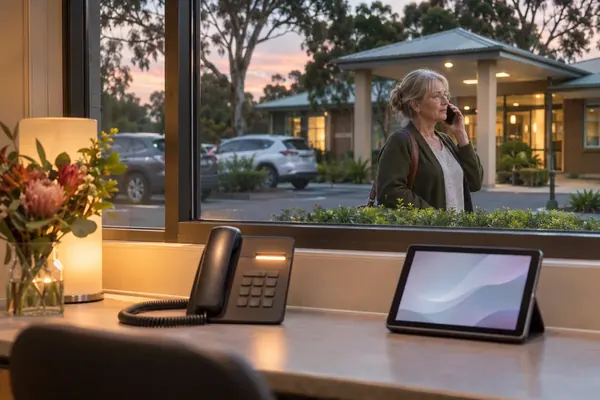
AI Phone Answering for Aged Care
Families, prospective residents, hospitals and agencies all ring the same number, often at handover or after the office closes. An AI phone agent answers the calls your staff cannot get to, deals with the routine ones and puts the urgent ones through to a person.

Policy Knowledge Assistant
Your policies and procedures run to hundreds of pages across shared drives, intranets and binders. A private AI assistant lets a care worker on night shift ask a plain question and get an answer drawn from your documents, with a link to the exact policy it came from.

Multilingual Communication
Many residents, clients and families speak a language other than English at home, and some older people return to their first language as dementia progresses. AI translation and a multilingual phone agent can handle routine messages in their language, while qualified interpreters stay in place for the conversations that matter most.
Talk it through with us
A free 30-minute video call about where admin time goes in your service and which task is worth automating first. No obligation, and no resident information needed.